Identify your skills
Identifying your skills is about evaluating what you have to offer, determining the direction that you want to take in life and bringing to the fore what makes you an exciting prospect for employers.
Familiarise yourself with different kinds of employers and roles to pinpoint the ones that are a good fit for your skills and make your goals clear in your own mind. This will help you to make more informed choices.
Identifying your skills is the first step on your journey
Start your job search journey by identifying and verbalising your skills. This first step is often the most challenging one. Identifying your skills helps you to
- tailor your CV and cover letter to each position,
- explain why you are the right person for the job and
- describe the value that you can bring to the organisation at your interview.
Remember the direction that you want to take in life and what you want to achieve. . Instead of just looking at your past and the present, focus on the future. Think about how your skills can be useful in different roles and working environments. This will also help you to broaden your prospects.
Identify and verbalise your skills
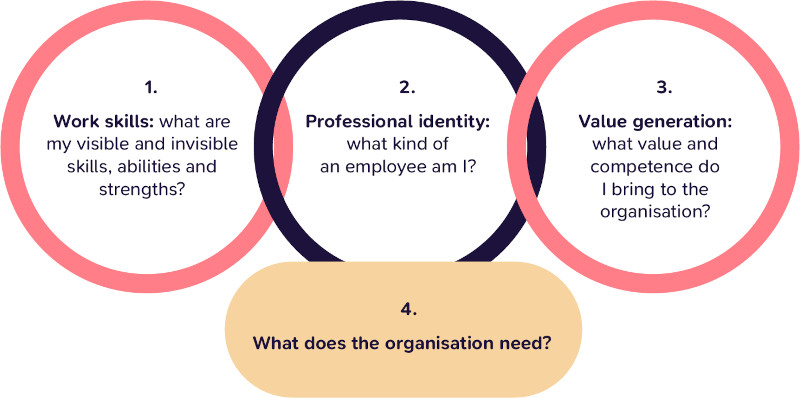
Use the graphic below to evaluate your potential from different perspectives. Identify your skills, abilities and strengths. Consider your professional persona: how does your professional role define you, what kind of a learner are you and how do you operate in a professional environment. Think about the skills and value that you will bring to the organisation and your future team. Measure your skills against the organisation’s needs at all stages of the process.
 Exercise 1: Identifying your skills
Follow the instructions to prepare a mind map or a table of your skills.
- List your professional skills.. Think back to your previous jobs or studies. Professional skills are skills related to a specific profession, role or industry
- List your general and transferable work skills. These skills are not tied to a specific role or industry. Transferable work skills include, for example, interpersonal and communication skills, problem-solving skills, time management skills, teamwork skills, adaptability and flexibility, self-management skills, the ability to learn, creativity and critical thinking. These skills are best expressed through concrete examples.
- Think about your personality and strengths. Your personality refers to, for example, how you have been described as a colleague, supervisor, partner or manager. There are various tests and tools available online that can help you to put your strengths into words.
- You can also consult artificial intelligence to get ideas how to describe your skills and strengths.
Remember
Remember to factor in both the visible and invisible aspects of your skill set. Visible skills can be demonstrated through qualifications and certificates. Invisible skills are tacit knowledge that you build up through experience.
Exercise 2: Get feedback
Ask your former colleagues or others who know you to answer the following questions:
- What skills and strengths do you think I have?
- How are these evident in how I operate?
- What feedback would you give me?
Write the answers down and compare them against your own assessment of yourself and what you wrote in the previous exercise.
Top Tip
Encourage the people who give you feedback to also do the exercise for themselves so that you can reciprocate and help them to identify their skills.
Exercise 3: Write a brief description of yourself
Now that you have completed the first and second exercises, you can use what you have learned so far to compile a brief description of yourself.
- Think about how you want to introduce yourself on paper and in person.
Remember to communicate your aspirations, goals and interests. A personal style can make you stand out from the competition. Make sure that the way you introduce yourself is clear and relevant to the job in question.
Prepare both a short and a slightly longer written introduction. Use the concise version in your CV and the longer one in, for example, your LinkedIn profile. You will also need a spoken introduction to be used at interviews or when meeting potential employers.